A Move-Out Sort for the Things You Actually Use
A move-out sort for the things you actually use helps you pack by real routines, arrange hand-me-downs with named recipients, and avoid carrying uncertain clutter.
The common move-out mistake is packing every object because it might be useful someday. That choice costs time at the new home, where uncertain boxes compete with belongings you need right away. A move-out sort for the things you actually use is easier when you decide each item’s destination before it reaches a box.
Which sorting approach fits your move?
Choose a method that matches your time and the decisions already made. Room-by-room sorting gives you a steady sequence. Recipient-first sorting works when someone has asked for particular belongings. A quick pass for items with no clear next job helps when you need to reduce undecided clutter.
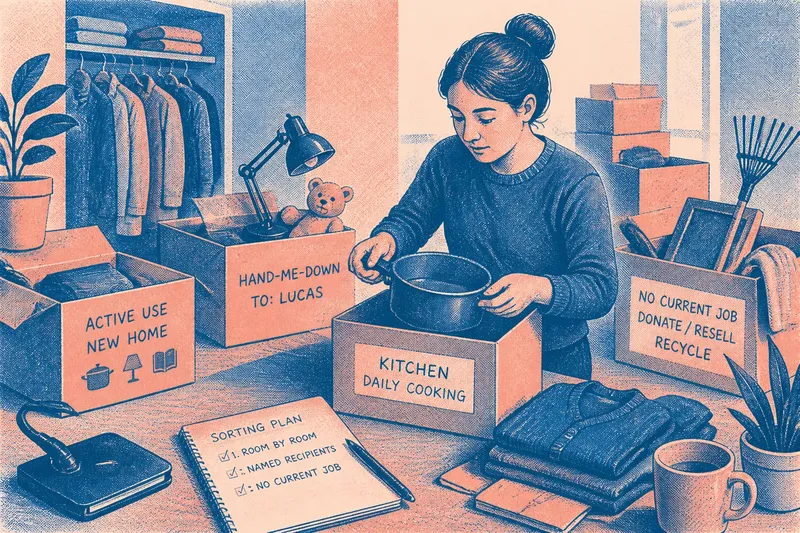
Most households can use room-by-room sorting as the main method, then set aside only items tied to a specific, agreed hand-me-down. For the rest, focus on whether the item serves a real routine in the new home.
What counts as active use?
Active use means an object has a job in the new home that you can name without relying on a vague possibility. A saucepan used for weekday meals, a desk lamp for a work corner, or a rake for a garden you plan to tend all have identifiable roles. “I might need it someday” does not describe a job.
Ask whether you use the item in its current role, whether that role will continue after the move, and whether the item is complete and usable. The answers help distinguish a real routine from a habit of storing things just in case.
Group active-use belongings by destination room or function. Label a box “kitchen—daily cooking” rather than “miscellaneous” so you can find useful things without opening several boxes.
How do you sort room by room?
Begin where the contents are easiest to assess and move through the home in a consistent direction. Mark three destinations: active use, a specific recipient, or no current job. A scrap of paper, reusable tote, or temporary box can keep decisions visible while you work.
- Kitchen: Check cookware and utensils against the cooking routines you expect to continue. If an item serves one of those routines, pack it for the kitchen; if it is a duplicate without a role, offer it to a named recipient or assign it no current job. Check pantry goods separately and follow local transport and disposal guidance where needed.
- Bedroom and closets: Check clothing for current fit and regular use. If a garment serves an actual occasion, pack it with clothing; if its only purpose depends on a hypothetical future change, do not pack it on that basis alone.
- Bathroom and laundry area: Check products and tools against ordinary routines and transport suitability. If an item is usable and fits a routine, pack it; if it is empty, unsuitable to move, or no longer needed, choose an appropriate local route instead.
- Living room and work area: Check furniture, lamps, books, and equipment for a planned place or activity. If you can name that destination, label it; if you cannot, consider an agreed recipient or a suitable local donation, resale, or recycling route.
- Storage spaces: Open boxes and check what is inside rather than moving sealed uncertainty. If hardware or accessories belong with an object you will use, group them together; if not, assess them separately for a recipient or local route.
Say you find two desk lamps in a spare room. Imagine one is working and will sit beside the desk you plan to set up, while the other has remained boxed and has no planned role. Pack the working lamp with the desk supplies; if a named recipient agrees to take the spare, mark it for that person, and otherwise choose a suitable local route instead of packing it by default.
When is a hand-me-down actually planned?
A hand-me-down is planned when a particular person has agreed to receive a particular item and there is a workable transfer arrangement. “Someone in the family could use this” is undecided, as is a message without a reply.
Before setting an item aside, name the recipient and agree on pickup or delivery. Describe any missing part or condition issue plainly. If the recipient declines or cannot collect it, decide on another suitable destination rather than leaving it in a holding area indefinitely.
Keep each person’s items together and mark them with the recipient’s name. That makes the transfer easier to manage and reduces the chance that a promised item is packed with household belongings.
How should you decide what has no current job?
“Not moving” does not automatically mean “throw away.” An item may suit a local donation center, community swap, resale, or appropriate recycling, depending on its condition and the receiving organization’s requirements. Identify a suitable destination before treating that route as settled.
- If you can name the item’s role in the new home, label it for that room or activity; if not, check for an agreed recipient or local route.
- If a specific person has agreed to receive it, mark the item with that person’s name; if not, do not label an unanswered offer as a hand-me-down.
- If the item is complete and usable, consider an appropriate recipient or local route; if it is damaged, decide whether you genuinely intend to repair it or whether another route fits better.
- If a local organization confirms it accepts that kind of item, assign that route; if it does not, ask about another suitable option.
- If none of these decisions applies, do not pack the item solely because it might someday be useful; leave it for a deliberate local disposition decision.
- If a box contains mixed or unknown contents, open it and identify the items; if you cannot assess them before packing, mark it clearly and set a time to decide before the move.
For disposal, donation, and transport questions that depend on local rules or an organization’s requirements, check those instructions before acting.
Which move-out sorting questions come up most often?
Should I keep an item I have not used recently?
Keep it if you can name a specific upcoming use in the new home, not merely a possible one. If it belongs to an occasional but real activity, group it with the other items needed for that activity.
How do I handle useful duplicates?
Decide how many serve a routine you expect to continue, then ask whether a named recipient wants the rest. If no one agrees to take a duplicate and it has no role, consider an appropriate local destination instead of packing it automatically.
What if I cannot decide before packing?
Use one clearly marked decision box rather than hiding the item among active-use belongings. Set a time to revisit it before the move; if you still cannot name a job or destination, decide deliberately rather than letting “undecided” quietly become “keep.”
Can a damaged item still be a hand-me-down?
Yes, if the recipient understands the condition and still wants it. Describe what is missing or not working so the offer does not transfer an unexpected repair burden.
How do you choose a sorting method?
Choose room-by-room sorting if you need a dependable sequence and belongings still serve recognizable routines. Use recipient-first decisions when people have already requested specific items. If time is tight, identify items without a clear next job while keeping a separate pass for essentials you already know you need.
For a fully worked example, imagine you are moving from an apartment with a small kitchen and a spare room. You use one saucepan every week, have a second saucepan stored at the back of a cabinet, and your cousin has asked for a reading lamp but has not yet confirmed pickup. First, label the saucepan you use for the kitchen box because it has a continuing job. Next, ask your cousin to confirm the lamp and a pickup arrangement; until the answer arrives, keep it out of the packed boxes and mark the decision clearly. Then inspect the spare saucepan: if it has no role in your new kitchen and nobody agrees to take it, assign it an appropriate local donation or recycling route based on its condition and the recipient’s rules. The result is a kitchen box tied to an actual routine, a hand-me-down only if the arrangement is confirmed, and no automatic commitment to move the duplicate.
Before sealing a room’s last box, check that active-use items have destination labels and promised hand-me-downs have named recipients. For a move-out sort for the things you actually use, that final check keeps an unclear decision from becoming an inconvenient box at the new address.